From Collectibles to Digital Infrastructure
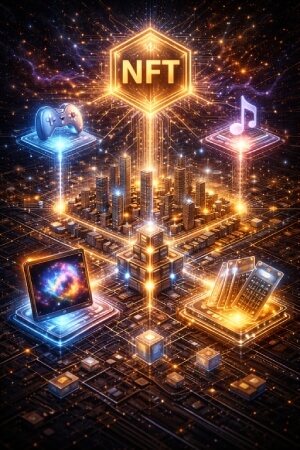
When NFTs appeared for the first time, people saw them mostly as digital collectibles that are only used for digital memorabilia. Remember that there is an age-old problem on the internet whereby digital files can be copied without any clear mark of who owns what. Early projects in the NFT domain showed that blockchain technology could tackle this problem.
We began to see the emergence of NFT marketplaces built on Ethereum and similar networks which allowed individuals to mint and trade assets globally.
As lay people showed more interest in NFTs, people’s point of interest started to shift from NFTs as collectibles or artworks to exploring the programmable framework behind these digital assets.
The ability to use smart contracts to establish rules guiding the sale, access and transfer of NFTs was a game changer. This meant that NFTs were no longer static items. They could serve as records of participation or digital certificates. NFTS started to find their place in areas like:
- Gaming
- Music
- Creative industries
- Ticketing systems
NFTs in Gaming: Ownership and Interoperability
NFTs in gaming serves as one of the earliest pioneers of the intrusion of the blockchain network into digital arts. Virtual assets have actually existed for decades in the form of things like weapon cases in Counter-Strike and skins in Fortnite. However, no player who won these things had an exclusive right of ownership. Licensing regulations prevented such.
All that changed in 2017 with the launch of CryptoKitties, a game that was built on the Ethereum blockchain. Within the game, users could breed, buy and sell digital cats as Non Fungible Tokens (NFTs).
The popularity of this game surged to the extent that it congested the Ethereum network. This was one of the incidents that showed the scalability problems associated with blockchain gaming.
The next evolution came with Play-to-earn (P2E) models. An example was Axie Infinity. In this title, a user was capable of earning tokenized rewards with real-world monetary worth. This new phase was so popular that it turned gaming from a mere entertainment outlet to a buoyant economic activity. The three main concepts behind NFTs include:
- True digital ownership: This means players can trade (buy or sell) in-game assets regardless of the game’s developer.
- Interoperability: In-game assets can be transferred between compatible metaverse environments.
- Player-driven economic ecosystem: The secondary trading and creator royalties happen in the marketplaces.
NFTs in gaming have their own fair share of problems. One is the unsustainable nature of the Play-to-Earn (P2E) model of operation of systems like Axie Infinity. It relies on the principle that new players will keep signing up, buying up NFTs and creating liquidity for people who are in the system.
In the case where the number of users were not growing as they should, the value of the tokens began to collapse. A potential solution to this problem to initiate other sources of revenue beyond sale of tokens. Examples include partnerships with companies and introducing user subscriptions.
Another downside is that some seasoned gamers feel that NFTs are making games too “artificial.” They feel that the incentive to make financial gains is overriding the fun experience behind a game. A potential solution is to separate NFT-based cosmetics from competitive gameplay.
NFTs in Music: Rights, Royalties, and Direct Monetization
Experimentation into NFTs in music started as far back as the middle of the 2010s. The drive behind trying to apply NFTs to music came from deep frustration and resentment with the way things operated in the digital music industry. The eureka moment came in 2021 when the Kings of Leon released an album as an NFT.
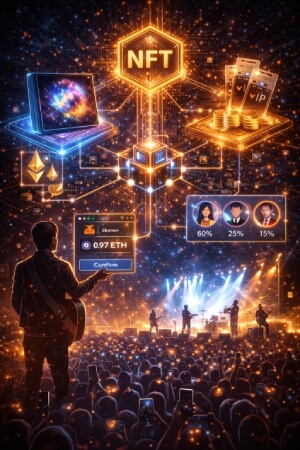
This was one of the first cases that we see artists leveraging on NFTs for distribution. In the time past, monetization in the music industry came from performing in live shows, placing songs and albums on streaming platforms like Spotify and through revenue from their record label.
In these means of earning revenue, there is a third party along the line. However, NFTs helps direct fan monetization via programmable digital ownership. This means that musicians enjoy a larger share of the revenue.
They can also sell limited edition digital albums and offer exclusive bonus tracks to their fans. When NFTs are resold, smart contracts are known to allow automatic royalty payments. Here are some of the other use cases of NFTs in music:
- Programmable royalties: Ethereum, as a smart contract platform, is known to distribute royalties automatically. This way, it is easier to digitally encode the contract from the beginning. The means by which the revenue will be distributed between writers, producers and other studio professionals will be in the contract. Artists can get the royalty every time their NFT is resold.
- Ticketing and experiential access: NFTs can help artists blend the physical and online world as the NFTs can serve as lifetime fan club memberships or concert tickets. The ticket can even be digital memorabilia after the event.
- Fractional ownership of music rights: A single artist doesn’t always own everything related to a song. For example, fans can invest in an album track and receive a part of the revenue.
Digital Identity and Web3 Authentication
As blockchain networks and ecosystems become more robust and mature, NFTs can serve as a means of decentralized digital identity and authentication. People can use it to prove who they are and know what they are entitled to. Let’s explore some of the problems with Web 2.0 and how NFTs can handle them. Typical internet identity systems are known to rely on:
- Social media logins
- Email-based verification
- Username and password combinations
One problem with the current internet is the storage of identity information on single corporate servers. This creates a single point of failure where a single hacking or data breach attempt compromised stored information. Also, once users submit their personal data, they have little control over what happens to it.
This point is where NFTs can serve as a cryptographic proof of achievement. The web 3 (blockchain) framework provides the proof that a credential exists and is part of a specific wallet. Use cases for this come into play on handling event attendance verification, membership badges, professional licenses and academic certificates.
Coincidentally, Ethereum and some newer networks are built on decentralized identity standards of which come specific attributes include proper information coordination across different platforms, self-sovereignty and selective disclosure of information.
Instead of submitting the same personal documents over and over again, the user can simply prove certain attributes such as being above 18 or serving as a licensed professional in a particular field.
Another concept that helps with digital authentication is something called soulbound tokens. Soulbound tokens are different from traditional NFTs in that they cannot be transferred or sold. This is useful in tracking things like employment records and governance participation history.
Furthermore, web 3 authentication does not rely on a password stored on a centralized server. Instead, the participants in the network have to use cryptographic messages to verify wallet ownership.
Token-Gated Communities and Ecosystem Building
NFTs are transformative in their role as something known as programmable access credentials. This means that NFTs are not just static assets.
They are dynamic properties that can be used to restrict access to resources in certain online communities. The term “token-gating” means the process of providing or denying physical or digital access based on the ownership of a specific NFT.
For example, joining an important Discord channel or getting early access to a video game could be based on the ownership of an NFT. With that structure in mind, NFTs are like VIP credentials or club memberships that can transform you from a passive consumer to a stakeholder.
One of the most popular examples of the Bored Ape Yacht Club. This simple community started from the humble beginnings of a profile-picture NFT collection to a bigger structure that includes licensing rights, merchandise and events.
Token-gated communities grow and evolve based on networking effects. As the popularity of the community rises, the demand for membership grows. More token holders join and see the community as a hallmark of success and increased engagement continues.
Furthermore, NFTs provide voting rights in decentralized organizations that involve things like treasury allocation and project maps. Token-gated communities are even becoming physical or hybrid (mix of physical and hybrid). There are real-world-membership clubs and conferences where people can attend to enjoy various benefits.
Challenges and Ethical Considerations Associated with NFTs
NFTs have played a big role in stretching the technological domain of the world we live in today. However, they have come with their fair share of challenges. We are now seeing new technical, social and legal problems associated with NFTs. Here are some of the problems.
Lack of global regulation/oversight: Just like cryptocurrency has no governmental oversight, NFTs likewise don’t have proper regulation. For example, different jurisdictions classify NFTs as different things such as property, security or commodity.
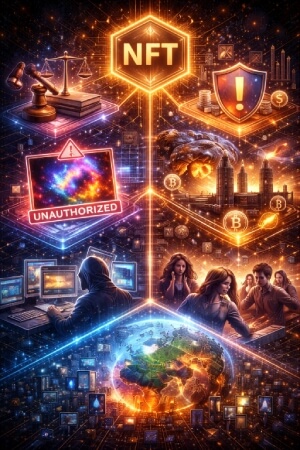
Also, some NFTs take the form of securities, in situations where profit expectations or fractional ownership are in view. Regulators in Europe, Asia and North America are trying to define what NFT marketplaces should look like and operate like.
Copyright Violations and Intellectual Property Theft
In the recent years since the widespread adoption of NFTs, we have seen trademark misuse as well as fraudulent parties who sell copyrighted materials without permission. We have also seen people who minted artworks without any prior authorization. Due to the inflexible nature of blockchains, the process of removing infringing content is complex.
Environmental Harm
The mining of new NFTs on blockchain networks is known to consume a large amount of electricity. Coal, gas and other fossil fuels are burnt round the clock to keep up to the task of producing NFTs. For this reason, the public has subconsciously linked the minting of NFTs to environmental destruction.
Digital Inequality
To buy NFTs and use them effectively, there is a need for people to have widespread access to the internet as well as the technical literacy to use crypto wallets. Despite efforts to bridge this gap, there are still regions with limited digital infrastructure.
NFTs Between Innovation and Uncertainty
Non-fungible tokens (NFTs) have come a long way since their early use cases as digital art collectibles. Now, they have seen wider use in music, gaming, ticketing, intellectual property licensing and more. The innovation is not in simply owning a digital item or artwork, it is in attaching things like rules, royalties and access rights.
When you play a game and win an NFT, you can own and trade the in-game rewards. NFTs in music offer artists a chance to get in close proximity with their fans and earn revenue from them. These “virtual tokens” also help people to prove their identity without always needing to submit their personal documents.
Nevertheless, NFTs come with their fair share of risks. We still have security risks, legal problems, copyright issues and instability in the market structure to contend with. How well would we be able to handle these problems? Will NFTs become an integral part of the digital economy? Or, will they just be limited to the boom-and-bust cycles? Time will tell.