What Are NFTs?
NFT stands for Non-Fungible Token. Now, we know that already sounds technical, but stay with us.
The word "Fungible" simply means interchangeable. For example, a dollar bill is fungible; you can swap it for another dollar bill, and you have the exact same thing. A Bitcoin is fungible, too, because one Bitcoin equals one Bitcoin, no matter which one you're holding.
"Non-fungible" means the opposite. It means something that is one-of-a-kind, that cannot be replaced or replicated, or interchanged with something else. For example, the original Mona Lisa painting is a non-fungible item. There's only one, and that's exactly what makes it valuable. The same thing applies to NFTs, just that they are not physical, tangible items.
In terms of definition, an NFT is essentially a unique digital token recorded on a blockchain that proves ownership of a specific digital item. That item could be an image, a piece of music, a video clip, a digital trading card, or even virtual real estate. The most popular ones back in 2021 were images.
But then, the important stuff isn’t the image itself. It’s the proof of ownership attached to it. In other words, the image is linked to a proof of ownership that lives permanently on a blockchain. It’s more or less like a digital certificate of authenticity, which only the actual owner of the NFT has.
Now, let’s talk about how NFTs are created and what makes them different from just ordinary pictures.
How NFTs Are Created
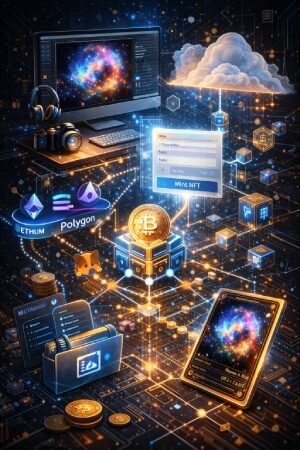
Every NFT begins with a digital asset, which, as mentioned earlier, can be an image, a piece of music, a short video clip, or a 3D model. At this stage, it’s just a regular digital file sitting on someone’s computer, and there’s nothing special about it yet.
To make the digital file into an NFT, the creator has to choose a blockchain network where the NFT will live. Most early NFTs were created on Ethereum. But then, other blockchains like Solana and Polygon later became popular too, especially because of their lower transaction costs.
After choosing a blockchain, the next thing is minting. Minting is the process of converting a regular digital file into a blockchain-based token. To do this, the creator must upload the digital file to an NFT marketplace and connect their crypto wallet. Connecting a crypto wallet is usually done through a browser extension wallet like MetaMask, which gives the marketplace access to your wallet address and the ability to interact with your NFTs, without handing over control of your funds.
After connecting your crypto wallet, here's a step-by-step breakdown of what happens next:
- The marketplace generates metadata for the NFT (e.g., name, description, traits).
- A transaction request is sent to the blockchain network to mint the NFT.
- A smart contract executes the minting process by creating a unique token ID.
- The network’s validators confirm the transaction and add it to a block.
- That block is added to the blockchain ledger, permanently recording the token ID and linking it to the creator’s wallet address.
When all these have been done, the digital file officially becomes an NFT. The blockchain now contains a record that says the wallet owner now owns the created token, and that token is linked to the digital file.
Now, anyone can copy or screenshot the image itself. But they cannot copy the blockchain record that proves ownership of the token, which is what makes it different from an ordinary picture. In other words, the NFT is not the image; it’s the verifiable ownership record attached to it.
It’s important to note that minting usually requires paying a gas fee. That’s the transaction cost paid to the network for processing and validating the NFT creation.
After minting, the NFT is stored in the creator’s crypto wallet. From there, they can just hold it, transfer it, or list it for sale on a marketplace.
NFT Marketplaces
As the name implies, an NFT marketplace is an online platform where people buy, sell, and discover NFTs. Creators can list their NFTs for sale on these platforms, and buyers can browse, bid, and purchase them.
Some of the biggest NFT Marketplaces include OpenSea, Blur, Magic Eden, and Rarible. OpenSea was the go-to marketplace during the 2021 boom. But then the basic mechanics behind all of these platforms work pretty much the same, just that each has its own feel, fees, and community.
How NFT Marketplaces Work
The first thing you’ll notice when you visit an NFT marketplace is that you can’t just create an account with an email and password like a normal website. Instead, you need to connect your crypto wallet. That wallet connection is what identifies you. It shows what NFTs you own and allows you to interact with the platform.
Once connected, here’s how things typically work.
Listing an NFT for Sale
Listing simply means making your NFT available for purchase on the marketplace. To do this, you must set the terms of the sale. You can sell at a fixed price. That is, you set a price, and if someone agrees to pay that amount, the NFT is automatically transferred to them once the transaction is confirmed on the blockchain. The NFT stays listed until someone buys it at that price or you take it down.
You can also do an auction listing. There’s the English auction method, where you set a starting price and a time limit. Buyers can then place bids, and when the timer runs out, the highest bidder wins.
There's also the Dutch auction, which works in reverse. You start with a high price that gradually decreases over time until a buyer decides the price is right and makes a purchase. This format is often used when sellers want to move an NFT quickly or when they're releasing a large collection and want to find a natural market price.
Some listings also include a reserve price, which is essentially a minimum. The auction runs normally, but if bids don't reach that threshold, the sale doesn't go through.
Buying an NFT
Once a buyer purchases an NFT, whether through a fixed price listing or a winning auction bid, a few things happen almost simultaneously. The payment leaves the buyer's wallet. The marketplace processes the transaction on the blockchain. A smart contract automatically handles the transfer, moving the NFT from the seller's wallet to the buyer's wallet and releasing the payment to the seller, minus the marketplace's fee.
Secondary Sales
Once an NFT is sold for the first time, it enters the secondary market. This is where prices can skyrocket or collapse. Some buyers might resell for profit, while some might hold long-term, hoping the collection gains value over time.
NFT Platform Fees and Royalties
Earlier, we mentioned that minting an NFT requires paying a gas fee to the blockchain network to process and validate the transaction. We have also mentioned marketplace fees, the cut that platforms take when an NFT sale goes through. Let's break down these fees one by one.
Gas Fees
Gas fees are transaction costs paid to the blockchain network every time any action that needs to be recorded on the blockchain happens. This could be minting an NFT, buying one, transferring one, or even canceling a listing in some cases.
These fees don't go to the marketplace, the seller, or the creator. They go entirely to the validators and miners, which are the people and systems running the computers that process and confirm transactions on the network.
Now, gas fees are not fixed. They fluctuate constantly based on how busy the network is at any given moment. When a lot of people are trying to make transactions at the same time, say, during a hyped NFT drop or a volatile crypto market moment, demand for network processing spikes, and gas fees go up with it. Consequently, during quieter periods, they drop.
Marketplace Fees
Marketplace fees are the charges that the NFT platform itself collects as a commission for providing the infrastructure, that is, the website, the listings, the search tools, and the smart contract framework.
Every time an NFT sells on a marketplace, the platform automatically takes a percentage of the sale price before passing the rest to the seller. This percentage varies by platform.
Royalties
Now, I’ve already made it clear that some people buy NFTs to resell them for profit. But before NFTs, the resale market was quite frustrating for artists. A painter could sell an original piece for $500, and five years later, that same piece could sell at auction for $50,000, and the original artist would see absolutely none of that money.
NFTs changed that with royalties. Now, when a creator mints an NFT, they can encode a royalty percentage directly into the smart contract. This is usually somewhere between 5% and 10%. What this means is that every single time that NFT is resold, the original creator automatically receives that percentage of the sale price.
What Gives an NFT Value?
An NFT is not inherently valuable. What gives it value is everything surrounding it, that is, who made it, what it represents, who owns it, and how many people want it. In other words, it's less about the technology that goes into making it and more about perception, scarcity, and demand. I think that’s pretty much the same way value works in the physical world.
Creator’s Reputation
Just like a painting by a famous artist commands a higher price than one by an unknown painter, an NFT minted by a well-known digital artist, a celebrity, or an established brand carries more weight from the start.
Scarcity
Most NFT collections are released in limited quantities. The hard cap on supply means that as demand grows, the value of each individual piece can rise simply because there aren't enough to go around.
Uniqueness
Even within a limited collection, not all NFTs are equal. Many collections assign different traits and attributes to each piece. The rarer the traits, the more valuable that specific NFT tends to be. And collectors actively hunt for pieces with rare attributes, which drives the price up further.
Community Strength
This has to do with how active, loyal, and growing the NFT community is. When we say an NFT has a “strong community,” we’re talking about the fact that there’s a large number of holders of that NFT who believe in the project, there are active discussions about the NFT on platforms like Discord or X (Twitter), there are members who promote and defend the project organically, and there might even be events, collaborations, or real-world meetups.
The stronger and more loyal the community, the more demand there tends to be for the NFT. And when demand increases while supply stays limited, prices can rise.
Celebrity and Brand Endorsement
When Justin Bieber, Eminem, Steph Curry, and others started publicly buying and displaying Bored Apes as their social media profile pictures, it signaled to the wider public that these were worth owning. And as a result, the values of those NFTs spiked. Visibility from these influential figures creates demand, and demand creates value.
Market Sentiment and Timing
NFT values also change with the broader crypto market. When crypto is up and people are feeling confident about digital assets, NFT prices tend to rise with the tide. On the other hand, when the market crashes, NFT values often follow.
Utility
Some NFTs do more than just sit in a wallet looking pretty. You can actually use them to access real-world perks like event access, merchandise, voting rights in a community, playable characters in games, or even revenue sharing. The more an NFT can actually do, the more reasons people have to want it, hold it, and pay a premium for it.
Trading History
If a piece of art has passed through the hands of notable collectors, it carries more prestige. In the same way, an NFT that has been bought and sold by well-known wallets or featured in high-profile sales carries a kind of digital legacy that adds to its desirability.
Where NFTs Stand Today
If you made it this far, you now know a lot more about NFTs than most people do, and probably more than you expected when you first clicked on this article. As we said, NFTs are still very much a thing, even though the values have tanked significantly since the peak period in 2021. But then, just like crypto, there’s a possibility for a comeback. And maybe, people may devise a more practical use for them.