NFTs and Decentralized Identity
Web3 is a fragmented layer of identity. All services are required to have individual accounts, usernames, and passwords. This is the starting point of identity in Web3, which is a wallet address. A wallet is used as a consistent identifier in decentralized applications.
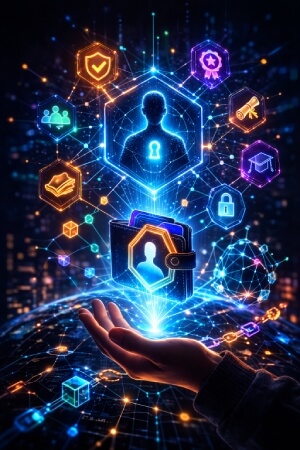
When users get connected to platforms, the authentication is done using cryptographic signature instead of centralized databases. NFTs improve this model of identity.
Membership, credentials, achievements or affiliations can be represented in terms of a token kept in a wallet. Blockchain records verify authenticity as opposed to verifying via centralized verification. This change turns the platform-controlling to the user-controlling identity.
NFT Credentials and Authenticate Accomplishments
NFT may take the form of digital certificates. They can be the indicators of attendance of the events, attending the governance votes, academic degrees, or professional success. NFT-based credentials can also be publicly verified without the use of intermediaries because blockchain records are tamper-resistant.
New identity systems experiment with non-transferable NFTs as the means of signifying reputation. These tokens are always attached to a wallet and they verify authenticity. NFTs can be the key component of a system of trust in the Internet as the decentralized identity models evolve.
Selective Disclosure Mechanisms and Privacy
Although blockchain transparency increases verification, it increases privacy issues. The portion of wallet activity can be observed in public, thus revealing the behavioral patterns. To solve this, developers are testing privacy preserving technology with selective disclosure.
Users can verify possession of some of their NFTs without displaying complete wallet histories. The trade-offs between transparency and privacy shall determine the development of identity NFTs in the real world.
NFTs within the Metaverse Ecosystems
Metaverse worlds are created by trying to form physical digital socializing, trading, and expressioning environments. The ownership layer of these environments is provided by NFTs. NFTs can take the form of virtual land plots, avatars, accessories, and in-games.
It is also different to the traditional online games where the assets are owned by publishers, unlike NFT-based assets that are owned by their users. This type of ownership enables the assets to be traded without depending on one platform to provide more independence and economic participation.
Digital Goods and Interoperable Avatars
Interoperability, or the possibility to use people on various platforms is one of the ambitions of Web3. The NFT-based avatars and wearables can also work in various virtual worlds in the future as long as the standards are compatible.
This demands compatibility of metadata structures and rendering structures. Although complete interoperability is still technically difficult, there is evidence of a wider conception of portable digital identity in the direction of shared standards.
Play-to-Own and Owner Economies
Another application of NFTs is play-to-owns. Gamers receive digital items with intrinsic values. This paradigm reinvents the gaming economies.
As opposed to having in-game purchases that are confined to closed systems, assets can be transferred. But economic sustainability is vital. In the absence of balanced incentive structures, speculative behaviors may decrease the quality of gameplay.
NFTs in DAO Governance
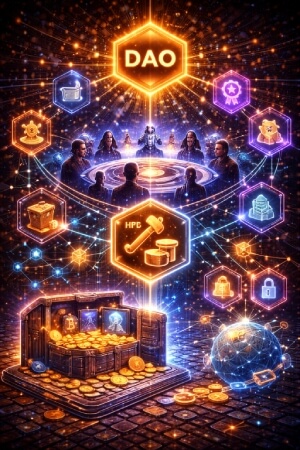
Decentralized Autonomous Organizations organize communities by means of blockchain-based governance. Membership in these organizations can be in the form of NFTs.
As opposed to fungible governance tokens, NFTs support privileged differentiation. NFTs can confer voting rights, proposal access or access to the treasury. This flexibility supports community-based layered structures of governance.
Reputation-Based Governance
Some DAOs even test non-transferable NFTs of contribution history. These tokens are used as reputation indicators. Since they are not traded, power is still attached to proven action as opposed to wealth accumulation. These models of governance aim to be transactional with normative decision making authority.
Collective Asset Management
DAOs tend to control common property, such as NFTs of digital art, intellectual property, or virtual land. The ownership is usually asserted using multi-signature wallets. The use, sales and leverage of assets are decided by community votes. NFTs, therefore, act as governance mechanisms and treasuries in decentralized organizations.
Tokenized Ownership and Economic Innovation
Here is an overview of how token ownership works and how it drives real-world economic innovation. An example is the fractional ownership structure.
Fractional Ownership Structures
NFTs of high value can be fractionalized and splintered into smaller tokens that represent small shares. This model reduces entry barriers, whereby wider access can be reached to digital assets that would doubtfully be prohibitively priced. Fractionalization poses new models of the economy, but demands elaborate systems of governance that regulate the decision-making process by a collective.
NFT standards added programmable royalty which enables creators to be paid on re-selling. This transforms creator economies so as to tie incentives to long-term activity in the market. There is a difference in the way sustainability of royalties is upheld although enforcement across marketplaces remains a constant focus towards continued developmental processes.
Representation of Real-world Asset
The concept of NFTs as digital images of real-life objects is analyzed as event tickets, property titles, and certification documents. These paradigms span from the physical to the digital economies.
Legality and regulatory certainty is needed to facilitate more widespread adoption. The tokenization has the potential to increase the access to the asset classes, as well as enhancing the level of transparency.
Cross-Chain Interoperability
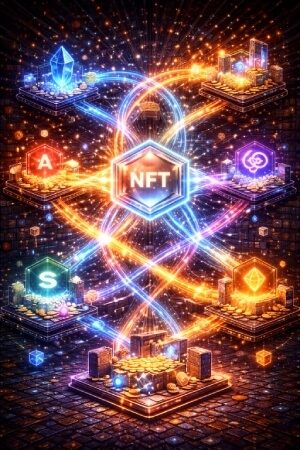
NFT ecosystems currently utilize more than one blockchain. The various chains have varying strengths in cost, speed and communities of developers. The interoperability is also more and more essential as the activity becomes widespread.
Users can desire to transfer assets across networks without compromising authenticity. Cross-chain bridges will also strive to allow this movement, but this comes with technical complications.
Compatibility and Standardized Metadata
Metadata standards need to coincide in order to permit NFTs to operate within ecosystems. Standardization allows attributes and ownership recordings and media files to be readable across platforms. Poor standards limit composability. Current development is geared towards the balancing of frameworks with the aim of enhancing cross platform integration.
Infrastructure and Security issues
Interoperability is a chance but a threat at the same time. Inter-chain bridges can be used as attack vectors in case they are poorly constructed. Vigorous cryptographic controls and clear auditing procedures are basic to sustainable cross-chain functionality. Increasing interoperability requires security to innovate.
NFT Standards and Technological Innovation
NFT technology continues to evolve beyond its original design as a simple proof-of-ownership token. Early implementations focused primarily on static metadata and basic transfer functionality. Today, developers are actively expanding NFT standards to support richer functionality, stronger interoperability, and greater flexibility across Web3 ecosystems.
Modern NFT innovation centers on making tokens more dynamic, programmable, and composable. Instead of functioning as fixed digital artifacts, NFTs are increasingly designed to adapt to changing conditions, user behavior, and cross-platform environments.
Dynamic and Upgradable NFTs
Traditional NFTs store metadata that rarely changes. Newer models introduce dynamic behavior, allowing tokens to evolve over time. This shift opens new possibilities for gaming, identity systems, and digital collectibles.
Dynamic NFTs may:
- Update visual traits based on in-game achievements
- Reflect governance participation or contribution levels
- Change attributes according to real-world data input
- Unlock new utilities after specific milestones
Some projects also experiment with upgradeable smart contract logic. While this introduces flexibility, it requires careful governance controls to maintain trust and transparency.
Improved Metadata and Storage Standards
Metadata standards determine how NFT information is structured and displayed across platforms. As NFTs expand into gaming, identity, and enterprise use cases, metadata requirements become more complex.
Evolving standards focus on:
- Richer attribute frameworks for multi-layer assets
- Improved compatibility across wallets and marketplaces
- Decentralized storage solutions to reduce reliance on centralized servers
- Version control for dynamic content updates
Standardized metadata enhances interoperability and ensures assets remain functional even as platforms evolve.
Composability and Cross-Protocol Integration
Composability is a core principle of Web3 architecture. NFTs are increasingly built to integrate with decentralized finance, identity layers, and metaverse engines.
Technical innovation enables NFTs to:
- Serve as collateral in lending protocols
- Act as access keys within decentralized applications
- Interact with staking or reward mechanisms
- Connect with cross-chain bridges for expanded utility
This modular design allows developers to build layered applications where NFTs are not isolated assets but functional components of broader systems.
Scalability and Efficiency Enhancements
Scalability remains a central challenge. As adoption grows, transaction costs and network congestion can limit usability.
Technical advancements aim to:
- Improve layer-2 scaling solutions
- Reduce gas fees for minting and transfers
- Increase transaction throughput
- Enhance energy efficiency through improved consensus mechanisms
These innovations strengthen NFT sustainability and prepare infrastructure for mainstream adoption. Collectively, evolving NFT standards and technical innovation are transforming NFTs from simple digital collectibles into programmable, interoperable assets embedded within the foundation of Web3 systems.
NFTs as Infrastructure for Web3
NFTs are being considered more of infrastructure than speculative. They are used as access keys, credentials of governance, and digital records of property. This infrastructural position makes NFTs a part of daily community digital transactions.
Information System and Integration Enterprise
Firms work on NFT-based authentication, ticketing, tracking the supply chain, and managing intellectual property. An institutional involvement can have an impact on policy and technology. The mainstream adoption will be characterized by a balance between the decentralization and compliance requirements.
NFTs also lead to archiving digitally. With decentralized systems, provenance and authorship are recorded on-chain. This permanence can reconstruct the way in which the digital culture is recorded and appreciated.
Web3 NFT Long-term Trajectories
NFTS can be in the form of credentials, certification and history of participation as decentralized identity systems mature. NFTs that are identity-linked might enhance cross-application authentication in the absence of centralized operators.
NFTs can enable the new models of economic coordination. Communities may tokenize common resources or works of creation or intellectual property. The administrative ownership can be programmable to allow new forms of revenue sharing.
Digital Ecosystems that are interoperable
The Web3 long term vision is interconnected digital spaces where resources flow freely between platforms. This vision can be achieved through standardized protocols, safe bridges and development in chains. It is anchored on NFTs as they encode ownership in the portable form.
NFTs as Programmable Ownership in Web3
NFTs will go much further than collectibles in the age of Web3. They are programmable ownership primitives embedded in decentralized systems of identity, models of government of decentralized autonomous organizations and tokenized economic networks. Chain interoperability, metadata standards, dynamic programmability and modular composability all keep expanding NFT functionality.
There are still challenges such as issues with scalability, regulatory challenges, and security risks. However, the technological basis of NFTs is developing.
With the development of Web3 infrastructure, NFTs can turn into more and more digital credentials, access controls, property rights, and governance power tools integrated in the form of decentralized networks. They will not only be affected by market conjecture in the long-term, but by their long-term utility, interoperability and fit with the trends in digital transformation.